


How to Get Rid of Roaches in Your Car: Guide for NJ Drivers


If you’re wondering how to get rid of roaches in your car, the answer is simple but requires consistency. You need to remove all food and clutter, deep clean every hidden area, use traps or bait to target what you cannot see, and fix what caused the problem in the first place.
Roaches do not stay in a clean, dry space without a reason. They are there because your car is giving them food, moisture, or shelter.
We see this often with daily drivers. Crumbs build up over time. Bags and clutter sit for days. Floor mats stay damp. Before you know it, your car becomes an ideal hiding place.
The good news is this is fixable. You just need to follow the right steps and not skip the details.
How to Get Rid of Roaches in a Car Step by Step?
Let’s break this down into a clear process you can actually follow. This is the most effective way to remove roaches and stop them from coming back.
Step 1: Remove all food, trash, and clutter
Start with a full reset.
Take everything out of your car, not just visible trash. This includes:
Fast food wrappers
Drink cups and bottles
Snack crumbs and containers
Grocery bags and reusable totes
Gym bags, boxes, and loose items
Roaches only need small food particles to survive. Even crumbs under a seat can keep them active.
If you skip this step, nothing else will work long term.
Step 2: Deep vacuum every hidden area
Once the car is empty, move on to a full interior vacuum.
Focus on areas where debris builds up:
Under seats and seat rails
Between seat cushions
Along floor mat edges
Inside cup holders and console
Trunk corners and seams
Take your time here. This step removes food, droppings, and possible egg casings.
According to pest control guidance, sanitation is one of the most important parts of eliminating roaches because it removes what keeps them alive.
Step 3: Use compressed air for tight spaces
Some areas are too tight for a vacuum. Use compressed air to loosen debris from:
Seat seams
Console gaps
Air vents
Then vacuum again immediately after. It helps remove hidden buildup that most people miss.
Step 4: Place sticky traps to monitor activity
Now that the car is clean, you need to track what is still active.
Place sticky traps:
Under seats
Near the center console
Inside the trunk
These traps help you confirm if roaches are still present and where they are most active.
Step 5: Use bait or gel for hidden roaches
Cleaning removes what you can see. Bait targets what you cannot.
Bait works because roaches carry it back to their hiding areas, which helps eliminate the source.
Avoid heavy use of sprays inside your car. In a small, enclosed space, sprays can leave residue and strong odors that linger.
Step 6: Repeat and monitor
This is where most people stop too early. Check traps over the next few days. If you still see activity, repeat the cleaning and monitor again.
Roaches reproduce quickly, so consistency is key to fully removing them.
Why Are There Roaches in Your Car?
Roaches do not randomly choose your car. There is always a reason they are there.
In most cases, your car is giving them exactly what they need to survive: food, moisture, and a place to hide.
Understanding this is important. If you only clean the surface but ignore the cause, the problem will come back.
Food buildup from daily use
This is the most common reason. Small crumbs from fast food, snacks, and coffee or sugary drinks can build up quickly, especially under seats and in tight spaces.
Roaches do not need much. Even tiny food particles can keep them active for days.
Moisture inside the vehicle
Moisture makes your car more attractive to pests.
This often comes from:
Spilled drinks
Wet shoes or umbrellas
Damp floor mats
Humid weather
In New Jersey, summer humidity can trap moisture inside your vehicle, especially if windows stay closed. This creates an environment where roaches are more likely to stay.
Clutter creates hiding spots
Roaches prefer dark, undisturbed areas. Items like grocery bags, cardboard boxes, gym bags, and loose storage give roaches places to hide and stay protected.
The more clutter you have, the harder it is to spot the problem early.
Roaches hitchhike into your car
Many infestations start outside your car.
Roaches can enter through:
Grocery bags
Takeout containers
Cardboard packaging
Luggage or storage bins
Once inside, they stay if your car provides food and shelter. This is why even clean-looking cars can still have a problem.
Signs You May Have a Roach Problem in Your Car
Not all infestations are obvious at first. In many cases, you will notice small signs before seeing actual roaches.
Seeing roaches at night or when the car is parked
Roaches are most active in dark, quiet conditions.
If you notice movement when you turn on the lights at night or when you enter your car after it has been sitting, there is likely more than one roach present.
Droppings, debris, or egg casings
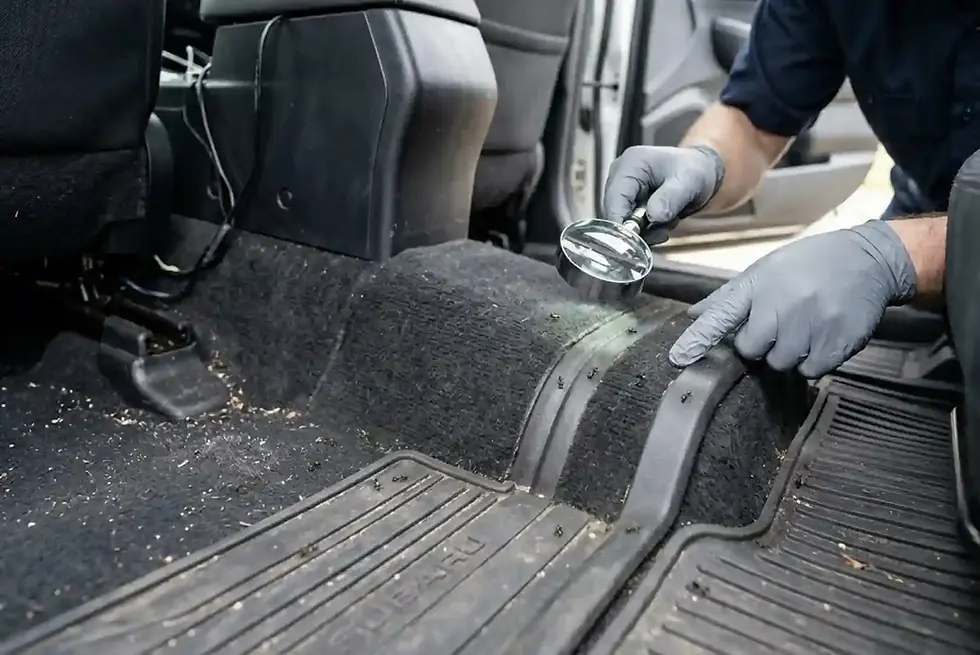
Roach droppings often appear as small black specks or look similar to ground pepper. You may also notice shed skins or egg capsules in hidden areas. These are strong signs that roaches are not just passing through, but may already be nesting inside your car.
Musty or unusual odor
Roaches can produce a noticeable smell over time. If your car has a musty, oily, or unusual lingering odor, it may be coming from buildup and pest activity hidden in areas that are not easily cleaned.
Activity returning after cleaning
If you clean your car and remove visible debris but still see roaches days later, the infestation is likely deeper than it appears. This usually means eggs are still present or roaches are hiding in hard-to-reach areas that were not fully cleaned.
This is not just a cleanliness issue. According to the EPA, cockroach droppings and body parts can trigger allergies and worsen asthma symptoms, especially in enclosed spaces like a car. That is why early action is important.
Where Do Roaches Hide Inside a Car?
If you miss the hiding spots, the problem does not go away.
Roaches are good at staying out of sight. They look for tight, dark areas where they can stay undisturbed during the day.
That is why many people think the problem is gone, only to see them again later.
Under seats and seat tracks
This is one of the most common hiding areas. Food particles fall here easily, and it is rarely cleaned thoroughly. Seat tracks also create narrow spaces that are hard to reach.
Beneath floor mats
Floor mats trap both crumbs and moisture.
If mats stay damp, especially during rainy or humid days in New Jersey, this creates a perfect environment for roaches to stay hidden.
Inside the trunk
The trunk is one of the most overlooked areas when it comes to cleaning. It’s easy for items like grocery bags, sports gear, emergency kits, and even cardboard boxes to pile up over time.
These items can trap crumbs, hold moisture, and create dark, undisturbed spaces, exactly the kind of environment roaches look for.
Center console and glove box
These areas tend to collect loose crumbs, small bits of paper, and everyday debris that build up over time. Since they’re usually closed and not cleaned as often, they become quiet, undisturbed spots where roaches feel safe enough to hide and even start nesting.
Air vents and tight interior seams
Some roaches can hide in very small spaces. Air vents and interior seams allow them to move through the car without being seen. This is also why surface cleaning alone is not enough.
What Kind of Roaches Are Common in NJ?
Not all roaches behave the same, and this matters when you are trying to get rid of them.
German cockroaches (most common problem)
These are the main issues in New Jersey.
According to Rutgers research, German cockroaches account for the vast majority of indoor infestations in the state.
Why this matters:
They reproduce quickly
They prefer indoor environments
They spread faster if not controlled early
If you are seeing repeated activity, this is often the type involved.
American and Oriental cockroaches
These are less common inside cars but still possible.
They are usually linked to:
Moist environments
Outdoor entry points
Garages or basements
If these are present, the problem may not be limited to your car.
Why identifying the type matters
Different types respond to different conditions.
For example:
Some prefer moisture
Others depend more on food sources
Some spread faster than others
Understanding this helps you choose the right approach and avoid wasting time on solutions that do not work.
Are Roaches in a Car Dangerous?
It is easy to think this is just an inconvenience, but roaches can create real health concerns. They leave behind droppings, shed skin, and saliva residue that can collect inside your car over time.
According to the U.S. Environmental Protection Agency (EPA), these particles can trigger allergies and worsen asthma symptoms, especially in enclosed spaces where air circulation is limited.
There is also a risk of bacteria spreading. Roaches move through unsanitary environments before entering your vehicle, and they can transfer contaminants onto seats, the steering wheel, and other interior surfaces. This is especially important if you eat in your car or have children riding with you, since these surfaces are touched often.
The longer the issue is ignored, the harder it becomes to control. Roaches reproduce quickly, so even a small problem can grow if not addressed early.
That is why combining proper cleaning, monitoring, and treatment is key to fully getting rid of them and preventing them from coming back.
Best Ways to Kill Roaches in a Car
At this point, you’ve cleaned your car and identified the problem. Now it’s about choosing the right method to eliminate what’s left.
Not all solutions work the same. Some only catch visible roaches, while others target the source.
Sticky traps (for monitoring and light activity)
Sticky traps are simple but useful. They help:
Catch visible roaches
Show where activity is happening
Track progress over time
However, they do not eliminate hidden infestations on their own. Use them as a monitoring tool, not a full solution.
Bait stations and gel bait (for deeper infestations)
Bait works by attracting roaches, which then carry it back to their hiding areas. This helps eliminate others you cannot see.
Best for:
Repeat sightings
Hidden nesting areas
Ongoing activity after cleaning
This method targets the source, not just the surface.
Deep cleaning (always required)
No product works without proper cleaning. If food, moisture, or debris is still present, roaches will continue to survive.
Deep cleaning removes:
Food sources
Odor buildup
Hidden debris
This is the foundation of any successful solution.
Professional pest treatment (for severe cases)
If the problem keeps coming back, it may be larger than your car.
Professional treatment may be needed if:
You see multiple roaches regularly
Activity continues after baiting
You find egg casings or strong odor
In some cases, the infestation may be coming from your home or garage, not just the vehicle.
What NOT to Do When Treating Roaches in Your Car?
Many people try quick fixes that make the problem worse. Avoid these common mistakes.
Do not use bug bombs inside your car
Bug bombs are not designed for small enclosed spaces like vehicles.
They can:
Leave chemical residue
Damage interior materials
Fail to reach hidden areas
They also do not solve the root problem.
Do not rely on heavy sprays
Spraying large amounts of insecticide inside your car might seem like a quick solution, but it often creates more problems than it solves.
The strong odor can linger in a confined space, the residue can settle on seats and surfaces, and it still may not reach the hidden areas where roaches are actually nesting. In a small, enclosed environment like a vehicle, this approach can end up doing more harm than good.
Do not skip cleaning
Products alone will not fix the issue. If food and debris remain, roaches will continue to return.
Cleaning is not optional. It is the first and most important step.
Do not ignore hidden areas
Many infestations continue simply because certain areas are overlooked during cleaning. The trunk is often left untouched, seat tracks are easy to miss, and the undersides of floor mats rarely get attention.
When these spots are skipped, you are only addressing part of the problem, which allows roaches to stay hidden and eventually return.
DIY vs Professional Help: What’s the Right Choice?
This is where most people get stuck. The right choice depends on how serious the infestation is.
When DIY methods may be enough
You can usually handle it yourself if:
You saw one or two roaches
There are no signs of nesting
The issue started recently
You can identify the cause (food, clutter, moisture)
In these cases, cleaning + bait + monitoring is often enough.
When professional help is the better option
You should consider professional help if:
Roaches keep coming back
You see them frequently
You find droppings or egg cases
There is a strong, persistent odor
The source may be your home or garage
If the problem keeps coming back or you are seeing clear signs of an infestation, it may be time to take the next step.
Instead of repeating the same cleaning process without results, it can be more effective to book a professional service that can properly inspect the situation and address the root cause.
Where interior detailing fits into the solution
Interior detailing is not pest control, but it plays a critical role in removing what attracts roaches in the first place.
It helps:
Remove deep, hidden debris
Clean hard-to-reach areas
Reset the interior environment
Without this step, even treated cars can become reinfested.
If your car has heavy buildup or you cannot fully clean tight areas, a professional interior detail can help remove the hidden debris that keeps attracting pests.
How Much Does It Cost to Get Rid of Roaches in a Car?
Cost depends on how long the problem has been there and how severe it is.
DIY costs
Basic supplies may include:
Sticky traps
Bait stations or gel
Cleaning tools
This is usually the lowest-cost option but requires time and consistency.
Professional pest control costs
Costs vary based on:
Inspection
Treatment method
Severity of infestation
If the problem extends beyond your car, treatment may include your home or garage.
Interior detailing costs
Detailing costs depend on:
Interior condition
Amount of debris
Time required to clean
Heavily used vehicles with buildup typically require more intensive cleaning.
What affects the total cost most
The biggest factors are:
How long the infestation has been present
Whether roaches are nesting
How clean or cluttered the interior is
Whether the source is inside or outside the car
The earlier you act, the lower the overall cost and effort.
Can a Car Wash Get Rid of Roaches?
This is a common question, and the answer is important.
A regular car wash helps maintain your vehicle, but it will not remove a roach infestation inside your car.
What a standard car wash helps with
A car wash is useful for:
Removing exterior dirt and buildup
Keeping your vehicle looking clean
Reducing grime that can be tracked inside
It plays a role in overall maintenance, especially if you are wondering how often you should wash your car, but it does not address the root of a pest problem.
What it does not solve
A car wash does not:
Reach under seats or inside tight interior areas
Remove hidden crumbs and debris
Eliminate roaches or their nesting areas
This is why many people clean their car but still see roaches afterward.
Why interior detailing makes a bigger difference
Interior detailing focuses on the areas that matter most. It includes:
Deep vacuuming
Cleaning under seats and mats
Removing built-up debris
Addressing odor and residue
This helps remove what attracts roaches in the first place. It is also worth noting that while some people try DIY methods like can you use dish soap to wash your car, these approaches are not designed for deep interior cleaning or pest-related issues.
If your car still has hidden debris or buildup after cleaning, getting a professional interior detail can help reset your vehicle and make it easier to keep pest-free.
How to Prevent Roaches From Coming Back?
Getting rid of roaches is only half the solution. Preventing them is what keeps your car clean long term.
Keep food and trash out of your car
Avoid leaving:
Wrappers
Drink containers
Snack crumbs
Even small amounts of food can attract pests.
Remove clutter regularly
Make it a habit to clear out clutter regularly. Bags, boxes, and loose items may seem harmless, but they can easily turn into hiding spots for roaches.
Keeping your car simple and organized makes it much easier to notice small problems before they turn into something bigger.
Keep your car dry
Moisture plays a big role in attracting roaches, so it is important to keep your car as dry as possible. Wet floor mats, spilled drinks, or damp items left inside can quickly create the kind of environment pests look for.
Try to dry mats right away, clean up spills as soon as they happen, and avoid leaving anything damp in your car. This becomes even more important during humid seasons, when moisture can build up faster than you expect.
Clean your car consistently
Regular cleaning helps prevent the buildup that attracts roaches in the first place. A quick vacuum under the seats, wiping down surfaces, and checking hidden areas every so often can go a long way.
It does not have to be complicated, but staying consistent makes a big difference in keeping your car clean and preventing problems from coming back.
Check what you bring into your car
Roaches often make their way into your car through everyday items you bring inside. Grocery bags, cardboard boxes, and luggage can all carry them without you noticing.
Taking a moment to check these items before placing them in your car can go a long way in preventing a bigger problem later.
When Should You Get Professional Help?
Sometimes, cleaning and DIY methods are not enough.
You should consider professional help if:
Roaches keep coming back
You see multiple roaches regularly
You find droppings or egg cases
There is a strong, persistent odor
The source may be outside your car
In many cases, the issue may not be limited to your vehicle alone and could be coming from your home, garage, or items you regularly bring inside.
Along with pest control, professional car wash services, especially those that offer interior detailing, can help remove built-up debris, odors, and hidden mess that continue to attract pests. A combined approach is often the most effective way to fully resolve the problem.
Why Ongoing Interior Cleaning Matters After a Roach Problem?
Once your car is clean, maintenance becomes your best defense. A well-maintained interior:
Removes what attracts pests
Makes issues easier to spot early
Keeps your vehicle more comfortable to use
This is where consistency matters more than anything else. If you want to maintain a clean interior and avoid buildup over time, regular interior cleaning or detailing can help you stay ahead of future issues.
Keep Your Car Roach-Free for the Long Run
Getting rid of roaches in your car is not about a quick fix. It is about removing what attracts them, treating the problem properly, and staying consistent with maintenance.
For NJ drivers, daily use, humidity, and clutter can make this issue more common than expected. But with the right steps, it is completely manageable.
When you combine proper cleaning, smart prevention, and the right level of treatment, you are not just solving the problem. You are creating a cleaner, healthier space inside your vehicle that is easier to maintain long term.
Frequently Asked Questions
Will roaches leave my car on their own?
No, roaches usually will not leave on their own if your car still provides food, moisture, or shelter. They tend to stay where conditions are favorable. Without proper cleaning and treatment, they are more likely to stay and multiply rather than leave.
Can roaches survive extreme heat or cold inside a car?
Roaches can survive a wide range of temperatures, but extreme heat can help reduce their activity. However, relying on temperature alone is not a reliable solution. Eggs and hidden roaches can still survive, which is why cleaning and treatment are necessary.
Can I drive my car while treating a roach problem?
Yes, you can still use your car during treatment, especially if you are using traps or bait. Just avoid using strong sprays or chemicals right before driving, as fumes can build up inside the vehicle. Always make sure the interior is safe and ventilated.
Can professional detailing alone remove roaches completely?
No, detailing helps remove food sources, debris, and odors, but it does not eliminate a full infestation on its own. It works best when combined with proper pest control methods. Think of detailing as a key part of the solution, not the only step.
Is it safe to use over-the-counter roach products inside a car?
Some products are safe if used correctly, but you need to be careful. Always follow label instructions and avoid overusing sprays in enclosed spaces. Bait and traps are usually safer and more effective for cars than heavy chemical sprays.
Can a dirty trunk cause a roach problem?
Yes, the trunk is one of the most overlooked areas. Food residue, bags, and stored items can create the perfect hiding and feeding environment. Even if the main cabin looks clean, a dirty trunk can keep the infestation going.

Comments